



June 16, 2026

Introduction
Colorado has had a flat tax for both individual and corporate income for nearly 40 years.[i] Currently, the rates are set at 4.4%. In November 2026, voters may be asked to decide whether to keep or discard the flat tax rate in favor of a progressive tax structure. Initiative #195 would implement a set of graduated rates ranging from 3.7% to 8.4%; the state estimates that this change would raise tax collections by up to $2.7 billion.
This report evaluates the potential fiscal and economic consequences of enacting Initiative #195. In recent years, Colorado has become less competitive with other states in terms of its tax structure. In the Tax Foundation’s 2020 State Business Tax Climate Index, Colorado ranked 17th in the country in tax competitiveness.[ii] In the 2026 edition, Colorado ranked 33rd.[iii]
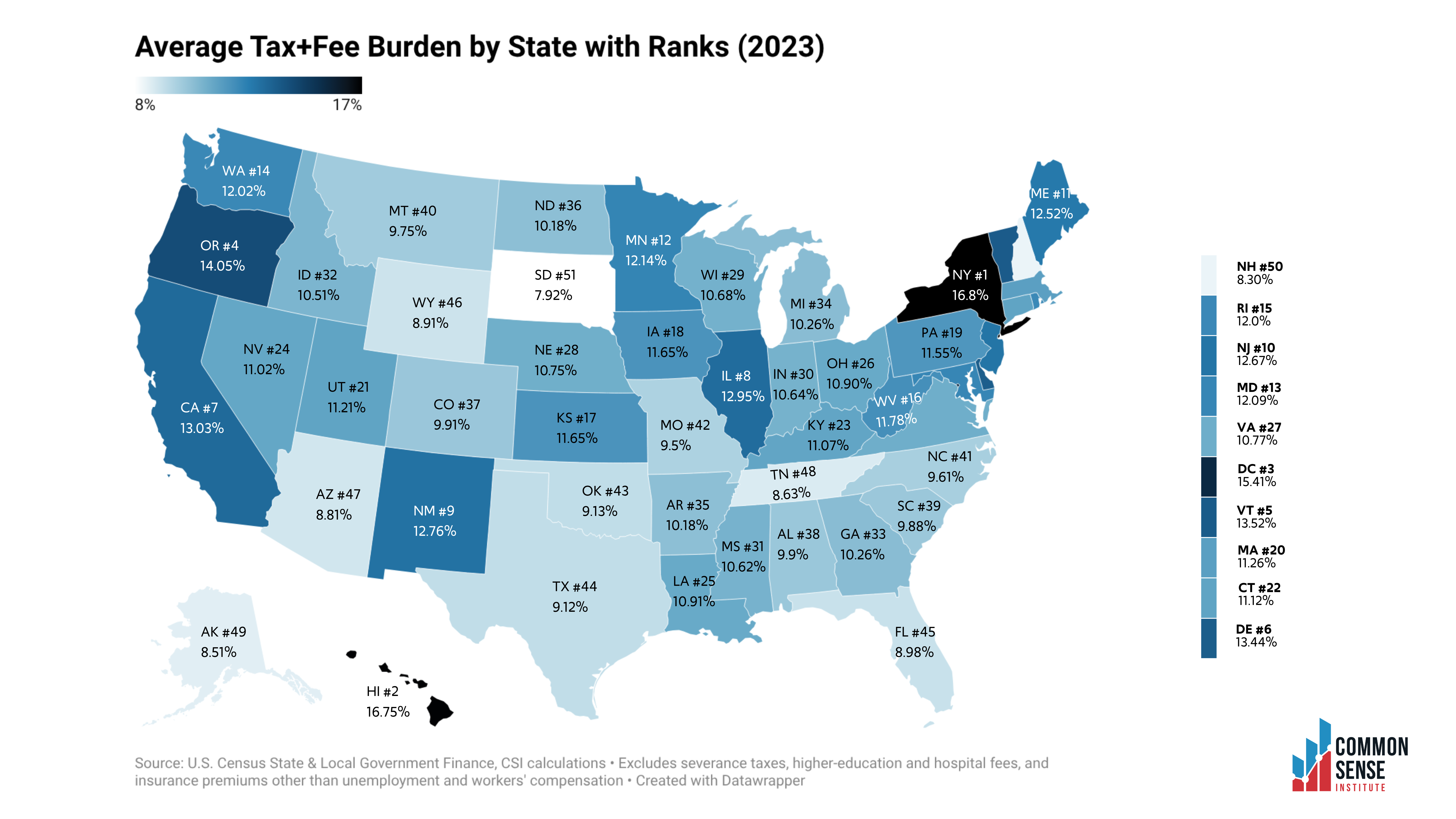
Passing Initiative #195 would cause Colorado to climb the national ranking of total tax and fee collections per resident. As the figure below shows, the average Coloradan’s current tax and fee burden ranks 37th-highest among states. If Initiative #195’s tax structure is enacted, Colorado would rank 33rd.
Key Findings
While a majority of taxpayers and businesses would pay lower taxes under Initiative #195, the state’s economy would suffer overall, creating consequences for every resident.
- Colorado would lose a net total of 14 firms and $200 million in corporate profits per year because of Initiative #195. In the top income bracket, the state would lose 29 firms that, together, earn $202 million annually and employ roughly 4,200 people.
- Colorado already is losing businesses faster than other states. According to the latest data, Colorado’s net firm migration is 6th-worst in the country.[iv]
- CSI estimates that the state would gain 386 net individual filers because of Initiative #195’s tax changes, but income disparities between those who arrive and those who leave mean that Colorado would lose $186 million in individual earnings per year to inter-state migration.
- CSI estimates passing Initiative #195 would raise the state’s average individual tax rate from 4.4% of taxable income (not including deductions and exemptions) to 5%, making it higher than the rates in all neighboring states but one.
- At 8.4%, Colorado’s top marginal rate under Initiative #195 would be the highest by far in the region.
While Initiative #195 would raise and retain new state revenue, the resulting taxpayer migration would cause those gains to shrink over time.
- The new tax rates would have statistically significant impacts on Colorado’s net migration of individual taxpayers across most income levels.
- This loss of wealth means that Initiative #195’s state-revenue increases would dwindle over time.
- The average Coloradan’s current tax and fee burden ranks 37th-highest among states. If Initiative #195’s tax structure is enacted, Colorado would rank 33rd.
- As a voter-approved tax increase, Initiative #195 would override revenue limits under the Colorado Taxpayer Bill of Rights, allowing the state to keep the extra revenue it generates from raising Colorado’s average income tax rate from 4.4% to 5%.
What Is Initiative #195?
Initiative #195 would eliminate Colorado’s flat tax and create a graduated income tax, beginning in tax year 2027, with marginal rates ranging from 3.7% to 8.4%. Any new tax revenue generated from Initiative #195 would be used to provide funding for K–12 education, healthcare, early childcare programs, and the Healthy School Meals for All program.
The fiscal note for Initiative #195 estimates that the measure will increase revenue from income taxes by an estimated $1 billion in fiscal year (FY) 2026–27, $2 billion in FY28, and increasing amounts in future years according to income and population growth.[v] The initiative’s sponsors call the proposal a “direct response to Colorado’s budget crisis, caused by state revenue limits and federal budget cuts.”[vi]
How Would Initiative #195 Affect TABOR?
Approved by voters in 1992, the Colorado Taxpayer Bill of Rights (TABOR) strictly limits the amount of revenue state and local governments can collect, retain, and spend. It states that:
- State and local governments cannot raise tax rates or create new taxes without direct approval from voters.
- Annual government revenue growth is capped by a formula based on the rate of inflation plus the state’s population growth.
If the government collects more tax revenue in a fiscal year than the cap allows, the surplus must be refunded directly to Colorado taxpayers.[vii]
Because Initiative #195 would be a voter-approved tax increase, the new revenue it proposes to generate is exempt from TABOR limits. The state government would keep this additional revenue instead of returning it to taxpayers in years with revenue excesses, but TABOR refunds in those years would be unchanged.
How Initiative #195 Would Apply to Resident and Corporate Earnings
Replacing Colorado’s flat income tax, Initiative #195 would create a progressive system of six brackets for both individual and corporate taxes. New tax rates would apply to income as follows:
|
Individual and Corporate Income-tax Rates under Initiative #195 |
|||
|
Bracket # |
AGI up to: |
New marginal tax rate |
Current rate |
|
1 |
$25,000 |
3.7% |
4.4% |
|
2 |
$100,000 |
4.2% |
4.4% |
|
3 |
$500,000 |
4.4% |
4.4% |
|
4 |
$750,000 |
7.4% |
4.4% |
|
5 |
$1,000,000 |
7.9% |
4.4% |
|
6 |
∞ |
8.4% |
4.4% |
All Coloradans currently pay a 4.4% individual income tax rate. As in every state with an income tax, Colorado’s highest-earning groups pay disproportionate shares of the state income tax: residents who earn at least $200,000 annually, representing 8.4% of Colorado households, shoulder approximately 48% of the state income-tax burden.[viii] Some progressivity already exists within Colorado’s flat-tax structure due to fixed standard deductions, personal exemptions, and credits that benefit low-income filers.
Under Initiative #195, the income tax code would become more progressive. Most taxpayers would pay a rate of 4.4% or lower; only filers who report one-year income above $510,833 would be charged more under Initiative #195. The changes for taxpayers above this income level would be significant, however. At 8.4%, Colorado’s top marginal rate under Initiative #195 would be the highest by far in the region.[ix]
Because distributions of personal and corporate income are right-skewed, the average income tax rate in the state would rise even though most residents would pay a lower rate under Initiative #195. CSI estimates passing Initiative #195 would raise the state’s average individual tax from 4.4% of taxable income (not including deductions and exemptions) to 5%, making it higher than the rates in all neighboring states but one.
|
2026 Income-tax Rates in Colorado and Neighboring States |
||||
|
State |
Type |
Lowest marginal rate |
Highest marginal rate |
Average rate[1] |
|
Kansas |
Graduated |
5.2% |
5.58% |
5.51% |
|
Colorado (under #195) |
Graduated |
3.7% |
8.4% |
5% |
|
New Mexico |
Graduated |
1.5% |
5.9% |
4.59% |
|
Utah |
Flat |
– |
– |
4.5% |
|
Colorado (currently) |
Flat |
– |
– |
4.4% |
|
Nebraska |
Graduated |
2.46% |
4.55% |
4.29% |
|
Oklahoma |
Graduated |
0% |
4.5% |
4.27% |
|
Arizona |
Flat |
– |
– |
2.5% |
|
Wyoming |
None |
– |
– |
0% |
Colorado Would Lose Some Residents and Businesses
Taxing income necessarily disincentivizes earning, though the extent to which it does is debated. In at least some cases, differences in income tax rates can repel movers from one state and attract them to another. In a study on federal and state tax progressivity, the Federal Reserve Bank of Minneapolis concludes that “households at all income levels who migrate from one state to another appear to be drawn to states with less progressive tax and transfer systems” and that “lower progressivity appears to be an especially powerful draw for very high income [sic] movers.”[x] Therefore, under a structure that lowers taxes for all but the highest-earning filers, wealthy individuals and highly profitable firms may leave while more lower-earning taxpayers arrive.
This section estimates the directions and magnitudes of these effects using national and state-level data, analysis of preexisting research, and statistical modeling.
Individuals
The U.S. Internal Revenue Service (IRS) maintains data on the migration patterns of individual filers by state and income level. Though these numbers have only been updated through the 2023 tax year, they help to demonstrate the principle that high earners, especially, tend to follow tax incentives. Notoriously, high-tax states like California and New York have lost wealthy residents to low-tax states like Florida and Tennessee.
Patterns like this can help researchers forecast the effects of adjusting tax rates across different income levels. To estimate migration trends at these additional levels of detail, CSI used national data on income distributions within the top percentile of taxpayers, findings from a 2016 study on high-income migration tendencies, and a simple measure of skewness in each state (mean adjusted gross income, AGI, divided by median AGI).[xi]
This report’s analysis of individual income-tax changes rests on six linear regression models— one for each distinct tax bracket proposed by Initiative #195—that seek to demonstrate relationships between state income-tax rates, states’ standard deductions (a control variable), and annual net taxpayer migration at different income levels. From these bivariate models, CSI found evidence that income tax rates affect interstate migration among five of the six brackets, the highest of which shows the strongest association. Although the models show that income taxes explain only a very small part of overall migration trends, their effects are statistically significant at α=.05.
|
Individual Income Tax Regression-analysis Results |
||||
|
Bracket # |
Coefficient: income-tax rate[2] |
p-value: income-tax rate |
F-statistic |
R2 |
|
1 |
-0.0335 |
0.4119 |
3.6962 |
0.1359 |
|
2 |
-0.0713 |
0.016 |
5.3328 |
0.185 |
|
3 |
-0.1043 |
0.0338 |
3.4293 |
0.1273 |
|
4 |
-0.1497 |
0.0107 |
4.6191 |
0.1643 |
|
5 |
-0.1504 |
0.0095 |
4.7459 |
0.168 |
|
6 |
-0.1629 |
0.006 |
5.2116 |
0.1815 |
Understandably, migration rates among the lowest earners, many of whom have zero or negative AGI, are practically unaffected by income taxes. Across all other brackets, however, there are clear and direct, if weak, relationships between taxes and movement patterns. In the case of Colorado’s proposed new rates under Initiative #195, these relationships mean that the state can expect:
- Net immigration of people earning between $25,000 and $500,000 per year,
- Negligible movement of those who earn between $500,000 and $1,000,000, and
- Net emigration of filers who report annual income above $1,000,000.
The magnitudes of these effects, calculated by subtracting Colorado’s predicted migration levels under the proposed tax rates from those at 4.4%, are reported in the following table.
|
Projected Annual Impacts of Initiative #195 on Net Migration of Individual Filers and Their Earnings |
||
|
Bracket # |
Net migration of individual filers |
Net earnings change (2025 dollars) |
|
1 |
Insufficient evidence |
Insufficient evidence |
|
2 |
351.44 |
$21,859,399 |
|
3 |
114.77 |
$23,712,186 |
|
4 |
-1.05 |
-$786,328 |
|
5 |
-1.72 |
-$1,786,513 |
|
6 |
-77.69 |
-$229,093,593 |
|
Total |
385.74 |
-$186,094,850 |
Although this methodology finds that about 386 net taxpayers would move to Colorado each year under Initiative #195, the concentration of losses within the richest segment of the population means that more wealth would exit the state than enter. This report assumes that the numbers above represent average yearly changes in perpetuity, but it may be that impacts would be larger in the short term and smaller in the long term.
Businesses
No such income-bracketed migration data exist for businesses, so CSI’s analysis simply treats corporate taxpayers as though they have the same migration propensities by tax bracket as individuals. This approach may overestimate results—if businesses are generally less likely to move than residents—or it may underestimate results because average profits among top-bracket businesses are more than double average earnings among top-bracket individuals.
|
Projected Annual Impacts of Initiative #195 on Net Migration of Corporate Filers and Their Profits |
||
|
Bracket # |
Net migration of corporate filers |
Net profits change (2025 dollars) |
|
1 |
Insufficient evidence |
Insufficient evidence |
|
2 |
8.43 |
$680,085 |
|
3 |
6.81 |
$2,679,503 |
|
4 |
-0.35 |
-$257,705 |
|
5 |
-0.30 |
-$300,261 |
|
6 |
-28.86 |
-$202,447,675 |
|
Total |
-14.28 |
-$199,646,053 |
Because businesses’ profits are, on average, much higher than personal earnings, taxing corporate profits at the same rates as individual income means that the loss of wealth in the highest bracket would be more pronounced for businesses. According to CSI’s analysis, corporations would generate 51.8% of the annual wealth lost to migration effects despite the fact that corporate tax collections accounted for just 10.1% of total income tax revenue in 2023.
Colorado has been losing businesses for some time, since about 2020, and Initiative #195 would worsen outmigration of corporations. In 2023, a net total of 58 businesses, which was the 6th-most in the country, moved from Colorado to another state; at a net loss of 72, Colorado’s count would have overtaken Massachusetts to rank 5th-highest.
State Revenue
Because Initiative #195 proposes to raise Colorado’s average income tax rate, it would increase future state government revenue as long as it would not result in an overwhelming decline in earnings among taxpayers. The Legislative Council Staff, which conducts fiscal analyses of citizen initiatives, estimates that the new tax rates would raise collections by $2 billion (or up to $2.7 billion given forecasting error) in the first full year after enactment and greater amounts thereafter according to income growth and inflation.
CSI expects very similar first-year revenue impacts: $2.3 billion, in 2025 dollars, based on average individual incomes and corporate profits across the six proposed tax brackets. Because this report’s methodology incorporates the effects of inter-state migration, however, it projects that the state-revenue impact will shrink, albeit slowly, over time. That decline would be the result of net-negative migration of wealth and the effects of higher taxes on corporate profits among firms that remain in Colorado.
According to CSI’s analysis, it would take 142 years at the pace of decline for the revenue impacts to turn negative. Still, along with their own tax interests, voters ought to consider whether a long-term revenue increase and the activities it funds are worth a contraction of Colorado’s private sector and a steady departure of wealth from the state.
Do Progressive Tax Rates Work?
Supporters argue that progressive tax rates reduce income inequality while generating revenue and having a limited effect on the economy. This section explores whether those assumptions are true, how progressive Colorado’s current tax system is, and the risks of adopting graduated tax rates.
Where Does Colorado Rank in Terms of Progressivity?
The Institute for Taxation and Economic Policy (ITEP) issues a report on state tax progressivity (including, but not limited to, income taxes) each year.[xii] Along with the District of Columbia, the most-progressive states are Minnesota, Vermont, New York, California, and New Jersey. The least-progressive states are Florida, Washington, Tennessee, Pennsylvania, and Nevada. Colorado already has one of the most progressive codes in the country, ranking 12th of the 50 states.
Although the state’s sales, excise, and property taxes are not progressive, its income-tax system, as noted earlier in this report, is relatively progressive despite its flat rate. Because of a high standard deduction and generous tax credits, the bottom 40% of earners in Colorado enjoy an especially low average income-tax burden. The bottom 20% of households have an average effective income-tax rate of -2.1% while those in the second-lowest quintile have an average effective rate of 0.7%. The top two quintiles have average rates above 3%.
ITEP highlights several aspects of Colorado’s tax code that increase its progressivity, like the requirement for combined reporting for the corporate income tax, a refundable Child Tax Credit and Earned Income Tax Credit, and its comparatively large standard deduction. If Coloradans want a more progressive income-tax system, eliminating the flat income tax is only one option; according to ITEP, others include property-tax credits for low-income homeowners and excluding groceries from sales taxes.
Progressive Income Taxes May Harm the Economy
A 2014 paper from the American Enterprise Institute examines whether there is a tradeoff between economic growth and progressive taxation. Using state-level data from 1979 to 2004, author James Pethokoukis concluded that such a tradeoff does indeed exist—income-tax progressivity has a significant negative effect on the current year’s growth rate. He offered three potential explanations for the decline:
- High-income, high-productivity people leave
- High-income groups, whose effective wages fall, substitute labor for leisure
- Small-scale innovation and entrepreneurship are disincentivized and fall[xiii]
The Tax Foundation has also studied the effects of income taxes on economic growth and employment. Along with noting that the inter-state mobility of wealthy taxpayers “works against the effort of progressive state and local tax systems to achieve long-term redistribution of income,” a 2022 report by the nonpartisan nonprofit reaches the following conclusions:
- Research shows a negative relationship between income tax rates and GDP.
- The likelihood of an employed head of household obtaining a better job within a year is higher when a tax system’s progressivity is reduced.
- A decrease in progressivity is associated with an increase in the real growth rate of wages.
- Changes in rates of private investment and private consumption are highly correlated with tax changes. Measures of the magnitudes of these changes vary, but the relationship between the variables is consistently inverse: as tax rates decrease, investment and consumption increase.
- Cuts to marginal tax rates are highly correlated with decreases in unemployment rates.[xiv]
Another report by the Tax Foundation finds that income inequality, one of the stated justifications of Initiative #195, is no lower in states with progressive tax systems than in others. Although replacing a flat tax with graduated rates necessarily reduces inequality, all else being equal, progressive taxation is not a reliable means of decreasing, nor even predicting, a state’s income inequality.[xv]
Finally, while the state’s policy is not identical to Initiative #195, Massachusetts implemented a higher income tax on wealthy households three years ago. According to the most recent IRS data, nearly 30,000 more people left than entered Massachusetts between 2022 and 2023—more net departures than almost any other state. According to the Massachusetts Budget and Policy Center, that net emigration represented a net loss of about $4.2 billion in adjusted gross income.[xvi]
Bottom Line
Raising taxes, even on a small segment of society, will result in tradeoffs. Enacting Initiative #195 would raise state-government revenue and reduce income taxes for most Coloradans, but the concentration of its impacts among wealthy residents and highly profitable firms would cause the state to lose wealth, reduce economic activity, and shrink local tax bases. In November, voters may have to decide whether these tradeoffs are worth it.
[1] For states with graduated taxes, estimated based on IRS income-tax filings data, wage data from the BLS, and original modeling. These values are not effective tax rates, which depend on factors like deductions and credits.
[2] The predicted effect on net migration of a state’s taxpayers (arrivals less departures divided by non-movers) in the given bracket of raising its average income-tax rate by 100 percentage points.
[i] https://content.leg.colorado.gov/agencies/legislative-council-staff/individual-income-tax%C2%A0
[ii] https://taxfoundation.org/research/all/state/2020-state-business-tax-climate-index/
[iii] https://taxfoundation.org/statetaxindex/states/colorado
[iv] Colorado Lost Workplaces at a High Rate in 2024
[v] https://leg.colorado.gov/initiative_files/3187/download
[vi] https://copolicy.org/news/coloradans-launch-2026-ballot-push-for-graduated-state-income-tax/
[vii] https://www.jeffco.us/3994/What-is-TABOR
[viii] https://completecolorado.com/2025/09/04/high-earners-disproportionately-more-colorado-income-taxes/
[ix] https://taxfoundation.org/data/all/state/state-income-tax-rates-2026/
[x] https://www.minneapolisfed.org/research/staff-reports/fiscal-progressivity-of-the-us-federal-and-state-governments
[xi] https://www.asanet.org/wp-content/uploads/attach/journals/jun16asrfeature.pdf
[xii] https://itep.org/whopays-map-7th-edition/
[xiii] https://www.aei.org/economics/study-making-a-tax-code-more-progressive-hurts-economic-growth/
[xiv] https://taxfoundation.org/research/all/state/income-taxes-affect-economy/
[xv] https://taxfoundation.org/research/all/state/response-cbpp-flat-income-taxes-don-t-endanger-public-finances-or-create-inequality/
[xvi] https://massbudget.org/2026/03/20/is-the-millionaires-tax-driving-wealthy-residents-from-mass-theres-new-data-but-still-no-clear-answer-boston-globe/
RECENT/RELATED RESEARCH
The Economic Impact of Hunting and Fishing and Its Connection to Amendment 83 – The First in a Two Part Series

The Economic Impact of Hunting and Fishing and Its Connection to Amendment 83 – The First in a Two Part…
Proposition 137: Sporting Goods Sales Tax Revenue for Conservation

Proposition 137: Sporting Goods Sales Tax Revenue for Conservation Introduction Proposition 137 would exempt existing state sales tax revenue on…

Proposition 132: Increasing Opioid Penalties

Introduction When Colorado voters take to the polls this November, one of the measures they will see is Proposition 132,…