


April 17, 2026
Experts:
Introduction
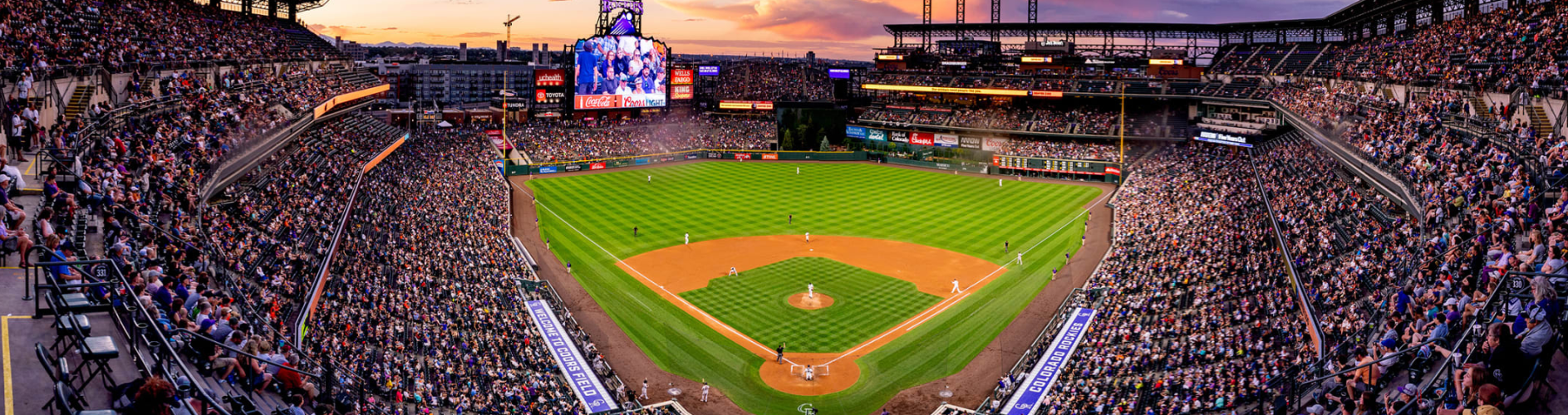
On March 25, 2026, the New York Yankees and the San Francisco Giants opened the 2026 MLB schedule. Baseball—America’s pastime and horizon sport—is now three weeks into its season. The Rockies, 2025’s doormat with just 43 wins and 119 losses, are off to a somewhat stronger start.
Attendance at Rockies’ games has ebbed and flowed through the years based, at least partially, on how well the Rockies are performing at the 50,144-capacity Coors Field (46,897 seating capacity).[i]
Figure 1

How much does an additional win add to home attendance? This depends, of course, on other factors like economic conditions, but there is a strong correlation between the two, with a top place team increasing attendance between 31% and 44%.[1] If the Rockies can improve from 43 wins in 2025 to, say, 95 wins in 2026, reaching the top of the standings would predict an attendance increase from 2.4 million fans over 81 home games to between 3.2 million and 3.5 million, a boost of between 31% and 44%.[2]
Figure 2
Of course, home-game attendance is not the only measure that would see a boost if the Rockies went from bottom-dwellers to top of the league. Increased attendance and better performance mean more visits from out-of-state fans and, because the Rockies would qualify for the MLB playoffs, more home games in Denver.
The remainder of this report estimates ranges of the broader economic impact that Colorado would reap if the Rockies became a winning, top-of-the-table team in 2026. The figures are intended to be indicative of the possible impact. If a final figure is ever known concretely, the figure is likely somewhere between the two extremes.
Because no published Rockies-specific estimate of out-of-state attendance was identified, this report uses a 5% to 25% range to bracket plausible outcomes. The upper bound is best understood as a high-end, most-optimistic scenario rather than the central expectation.
Key Findings
- Although Rockies fans are more loyal than most, winning substantially increases attendance at Coors Field.
- An improvement from last place (43 wins in 2025 against 119 losses) to a top-performing season (approximately 95 wins) would generate an estimated 44% increase in attendance, raising total home attendance from approximately 2.4 million to 3.5 million.
- Out-of-state visitors comprise a meaningful share of attendance. Unknown, there may be between 5% and 25% of fans coming to Rockies games from outside Colorado, representing roughly between 120,000 and 600,000 annual visitors under baseline conditions and more under a winning scenario.
- Moving from last to first place would bring an estimated 55,000 to 275,000 additional out-of-state visitors during the regular season, generating between approximately $37 million and $185 million in new direct spending in Colorado during the regular season.
- Playoff participation drives further economic activity. A first-place finish could occasion up to 11 home playoff games, contributing an estimated $33 million to $77 million in additional visitor spending and bringing total new direct spending to $70 million to $262 million.
- Total economic impacts extend beyond direct spending. Including indirect and induced effects from just out-of-state visitors, a first-place Rockies team boosts the state’s economy by between 1,736 and 7,341 jobs, between $193 million and $815 million in GDP, between $120 million and $509 million in personal income, and between $318 million and $1.3 billion in output.
- The mid-range of the personal income equates to $50 per person in the state.
- The mid-range of the jobs is more than half of the amount created in the state in January (6,600) and would be a substantial boost to a state economy that lost 11,700 jobs in 2025.
The Analysis
The analysis is divided into three sections. The first section looks at the relationship between attendance and wins, finding that winning teams, including past Rockies teams, had stronger attendance. The second section estimates the number of out-of-town visitors to Denver at Rockies home games. The third section evaluates what a trip to the MLB playoffs would mean for Colorado’s capital city. These three combine to form an estimate of the overall economic impact for Colorado should the Rockies find a way to improve from last in 2025 to first in 2026.
The Relationship between the Rockies’ Performance and Attendance at Coors Field
The Rockies finished 2024 dead-last at 43 wins, 17 wins behind second-to-last Chicago White Sox. Their poor play hurt their attendance, which ranked 16th by the end of the season—well above last, but much lower than in more successful years. In the Rockies’ five best years—2007, 2009, 2018, 2017, and 1995—the team occupied the top quadrant of attendance and wins (top right of the following chart) in all but one case. Across its 33 full seasons as a professional stadium, Coors Field has been MLB’s best-attended ballpark seven times (not including 2020).
A better record generally means better attendance, as shown by the upward-sloping green line in Figure 3, not only from in-state fans but from fans coming from out-of-state to see a winning team take the field.
Figure 3
How much attendance could the Rockies expect if the team improved from 30th-place in wins to 1st? The historical relationship between record and attendance predicts a major boost. If the team repeats last year’s record in 2026, Coors Field would be predicted to attract 2.4 million fans over the course of the season.[ii] Should the Rockies find a path to the top spot, winning around 95 games in 2026, predicted attendance would be between 3.2 million and 3.5 million, a 31% to 44% increase from last year’s 16th-ranked attendance figure.[3]
Out-of-town Visitors
Every Rockies home game draws both resident and non-resident fans, but no published survey measures the out-of-state share of spectators. Several indicators, however, suggest that Coors Field attracts a sizeable nonlocal audience: Denver’s large visitor base, Coors Field’s role as a major tourist attraction, Colorado’s large population of transplants, and reporting that away-team fans bolster Rockies attendance.[iii],[iv],[v],[vi] Given this, the share of fans at games likely ranges between 5% to 25%. This report provides that range, between approximately 120,000 to 600,000, of the 2.4 million fans who attended Rockies games in 2025 came from outside the state.
Playoffs
A top-performing team has the added advantage of not only potentially playing for the World Series trophy but also having more visitors at home games. If the Rockies were to achieve first place and play all potential playoff games throughout the playoffs, the number of extra home games would reach 11.[4] That’s 11 additional games at home that the Rockies did not play in 2025. The model assumes a 10% boost in the share of attendees from out-of-state visitors for playoff games.
Spending
In addition to the increased number of visitors to the state and more home games, Colorado’s economy would benefit from increased spending brought into the Denver area by out-of-state spectators. The following list has the estimates for hotels, restaurants and bars, groceries, transportation, game tickets, other entertainment, and souvenirs and gifts.
In addition to the figures reported below, the model assumes 2 games attended per visitor, an average trip duration of 3 days, and an average party size of 1.5. The direct out-of-state spending figures are:
- Hotels: $225 per night.
- Restaurants and bars: $60 per person per day.
- Groceries: $25 per person per day.
- Transportation: $40 per person.
- Game tickets: $45 ticket.
- Souvenirs and gifts: $15 per person per day.
Overall, these spending figures by out-of-state visitors to Rockies games equate to total out-of-state spending of between $113 million and $480 million.
Overall Economic Impact in Going from #30 to #1
Direct Economic Impact
Given this background, what is the overall economic impact should the Rockies make the leap from last place to first? As stated above, improving from 30th-place to 1st-place would draw an additional 800,000 to 1.1 million fans to games. Assuming that between 5% and 25% of the additional fans would come from out-of-state, that’s between 55,000 and 275,000 additional tickets to Rockies games from visitors. These 55,000 to 275,000 visitors would drive an additional $37 million to $185 million in spending activity in the state.
Of course, the $37 million to $185 million is not everything. A first-place team will qualify for the MLB playoffs and could potentially make it to the World Series. That means up to another 11 home games and between $33 million and $77 million more spending from out-of-state visits to Denver. The additional interest in attending Rockies games plus potential extra playoff games would generate $113 million and $480 million in direct spending.
Complete Economic Impact (Direct, Indirect, and Induced)
The $113 million to $480 million in direct spending from out-of-state visitors represents only one layer of economic activity. As these dollars circulate through the Denver economy, they generate additional rounds of impact. Indirect impacts occur as hotels, restaurants, transportation providers, and entertainment venues purchase goods and services from local suppliers to meet increased demand. Induced impacts arise when employees in these industries spend their wages on housing, retail, healthcare, and other household needs, further benefiting local businesses. Together, these ripple-effects amplify the initial visitor spending, producing a total economic impact that exceeds the direct expenditures associated with increased attendance at Colorado Rockies games. The following list and table summarize the overall range in economic impact:[5]
- A boost to employment of between 1,736 and 7,341 jobs. Those jobs would have helped offset a total loss of 11,700 jobs in 2025.[vii]
- A boost to GDP of between $193 million and $815 million.
- Between $120 million and $509 million in new personal income, enough to cover dinner and a movie for each resident of the state ($50 per person).
- An overall increase in economic activity (output) of between $318 million and $1.3 billion.
Figure 4
Bottom Line
In sports, as in most other spheres, winning pays off. Should the Rockies flip the switch from last place to first place, the impact from just additional out-of-state spectators generates enough economic activity for every resident to earn an extra $50—money that won’t show up if the Rockies stay in last place in 2026.
Appendix

[1] This is based on the regression results presented in the Appendix.
[2] Rounding to the nearest hundred thousand accounts for any difference between absolute attendance growth and percentage growth in attendance.
[3] The logarithmic regression results supporting the 31% to 44% boost is given in the Appendix.
[4] As the first place team, the Rockies would have a bye from the Wild Card series. Their first playoff series would be a best-of-5 Divisional Round (3 home games possible). This would be followed by the best-of-7 National League Championship Series (4 home games possible). This would then be followed by the best-of-7 World Series (4 home games possible).
[5] The model uses REMI Tax PI+’s Industry Sales for the mentioned industries as direct inputs into the model.
[i] Coors Field Ballpark Information, Major League Baseball, accessed April 15, 2026.
[ii] MLB Attendance Report, 2025 Season, ESPN, accessed April 15, 2026.
[iii] Visitor Impact Data, Visit Denver, accessed April 15, 2026.
[iv] What Can Help Fix the Colorado Rockies? Colorado Public Radio, July 17, 2025.
[v] Coors Field Visiting Fans Boost Attendance, ColoradoBiz, accessed April 15, 2026.
[vi] What Can Help Fix the Colorado Rockies?, Colorado Public Radio, July 17, 2025.
[vii] Colorado Employment Situation, January 2026, Colorado Department of Labor and Employment, accessed April 15, 2026.
[viii] Lahman Baseball Database, R-Universe, accessed April 15, 2026.
[xi] U.S. Bureau of Labor Statistics, Unemployment Rate in Denver-Aurora-Lakewood, CO (MSA) [DENV708URN], retrieved from Federal Reserve Bank of St. Louis, FRED database, accessed April 16, 2026.
RECENT/RELATED RESEARCH
Nuclear Power and the Future of Energy in Colorado
Key Findings Colorado’s electricity demand is projected to more than double by 2050. State-contracted modeling projects annual demand of 120…
Ballot Issue 7A: Proposed Tax for Front Range Rail

Ballot Issue 7A: Proposed Tax for Front Range Rail Key Findings The proposed sales tax would reach many residents without…
Ballot Issue 2J: Boulder’s Proposed Residential Vacancy Tax

Ballot Issue 2J: Boulder’s Proposed Residential Vacancy Tax Introduction On November 3, 2026, City of Boulder voters will decide whether…
