In September, Colorado added 500 total nonfarm jobs. The state’s private sector lost 200 jobs, while government employment grew by 700 jobs.
After dipping 0.3 percentage points in August, Colorado’s unemployment rate fell again in September by 0.1 of a percentage point, reaching 4.1%. This is the state’s lowest rate since May 2024, when it also stood at 4.1%. Nationally, unemployment rose by 0.1 of a percentage point in September to 4.4%. The resulting 0.3 percentage-point gap between Colorado and the nation is the largest since October 2023.
The 700 public sector jobs added in Colorado in September came entirely from growth in state government. Both federal and local government employment saw no change. The state's trade, transportation, and utilities sector led the private sector in jobs lost in September, with employment in the sector down by 2,100. Other critical sectors also recorded employment declines: construction (-1,000), manufacturing (-100), and mining and logging (-200).
The largest growing private sector in September was the state’s professional and business services, which grew by 1,700 jobs. Over the past 12 months, Colorado has added 10,400 private sector jobs, compared to 7,700 public sector jobs.
Key findings
- Colorado gained 500 jobs in September. The state’s private sector declined by 200 jobs while government employment increased by 700.
- Over the last 12 months, Colorado’s government employment has grown by 7,700 jobs while private employment has increased by 10,400 jobs.
- Colorado’s unemployment rate decreased 0.1 of a percentage point to 4.1% in September. It is below the national rate of 4.4%.i The resulting 0.3 percentage point gap between Colorado and the nation is the largest since October 2023.
- The construction industry lost 1,000 jobs in September. This industry has lost 3,200 jobs over the last year.
- Over the past year, federal government employment in Colorado declined by 2,900 jobs while state and local government employment grew by 9,100 and 1,500, respectively.
- The trade, transportation, and utilities sector lost 2,100 jobs in September while the manufacturing sector remained mostly steady.
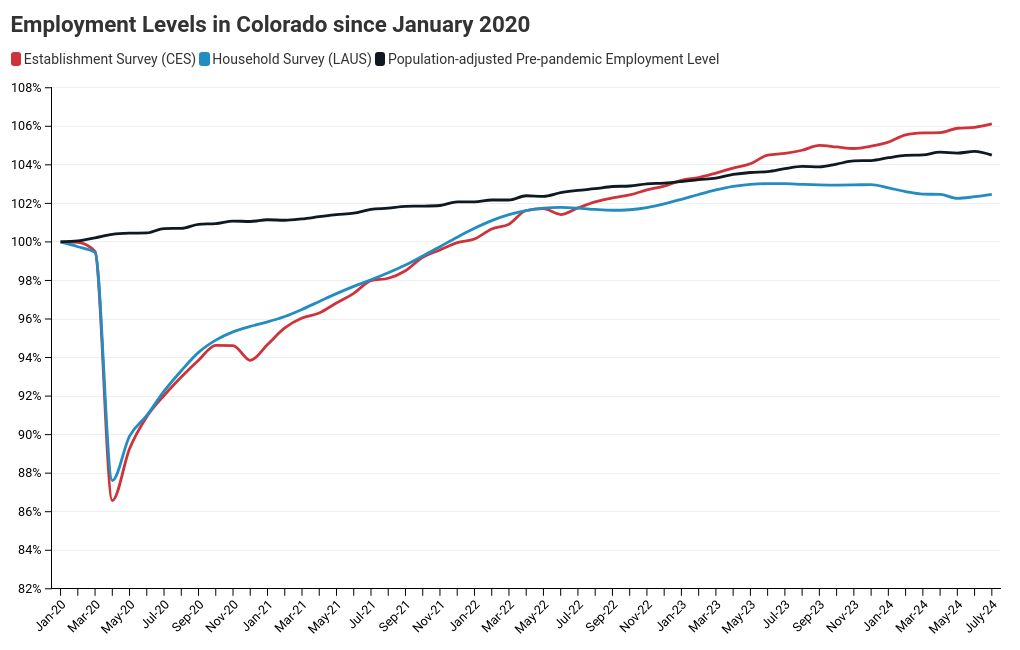
According to the BLS survey of establishments (CES), Colorado’s employment-to-population ratio has not exceeded its pre-pandemic level since June 2024.
Based on the BLS survey of households (LAUS), which captures both traditional jobs and self-employment, Colorado has never recovered to its pre-pandemic employment-to-population ratio.
A Deeper Dive Into Colorado Industries
Employers added a net total of 500 jobs in September. Private employment decreased by 200 while public employment increased by 700. Since last September, government employment has grown by 7,700 jobs while private employment rose by 10,400 jobs.
- The construction sector saw a decrease of 1,000 jobs in September.
- The trade, transportation, and utilities sector lost 2,100 jobs last month.
- Colorado’s professional and business services sector gained 1,700 jobs.
- Employment in Colorado’s leisure and hospitality sector grew by 400 jobs.
- Employment in the state’s mining and logging sector fell by 200 after remaining at 21,800 for three consecutive months.
The pandemic caused a major shock to the composition of Colorado’s job market in early 2020 and may have induced some structural changes in the long run.
- The state’s manufacturing sector has seen its share of total employment fall by 7.5% since the start of 2020.
- Since January 2020, the mining and logging sector has seen its share of state employment fall by over 24%. This is likely the result of a combination of global trends and state policy.
Colorado Unemployment Rate
Colorado’s unemployment rate in September was 4.1%, 0.3 of a percentage point below the national unemployment rate of 4.4%.
Historically, Colorado’s unemployment rate has been well below the national average. Between November 2023 and August 2025, it was higher.
Colorado Labor Force Update
Colorado’s LFPR (labor force participation rate) decreased by 0.1 of a percentage point to 67.3% in September. The national LFPR for the month of September was 62.4%.ii
ii https://fred.stlouisfed.org/series/CIVPART