Starter Home (SH) Zoning Template for freestanding single unit dwellings
Foreward
For generations, homeownership has been part of the American Dream. Why? Because a home is the foundation of opportunity. It is where stability begins, where futures are planned, where children grow, and where participation in civic and economic life first becomes possible. In the modern era, starter homes also have offered entry into the middle class: a modest, stable investment from which families built equity, security, and a sense of belonging within their communities.
Today, that dream is dying. Starter homes have all but disappeared from the Colorado marketplace.
That reality has far-reaching implications for the state economy, community vibrancy, and family stability.
Coloradans Can No Longer Afford to Live Where They Work
Before exploring a solution to that loss, let’s define what a starter home is. Generally, it is thought of as a small, freestanding, single-unit home, generally totaling no more than 1,000 square feet, built on a modest lot, sometimes with an accessory dwelling unit and sometimes without. It may be site-built, modular, or manufactured. What distinguishes the starter home is not its construction method, but its regulatory treatment. Once land is appropriately zoned and subdivided, these homes proceed through clear, objective administrative approvals tied to health, safety, and form, not discretion, delay, or negotiation by attrition. The intent is straightforward: by reducing regulatory burdens, policymakers facilitate the most attainable form of homeownership and lessen the time, cost, and risk required to build starter homes.
Colorado clearly has not achieved these goals. Lower-priced homes are simply not being produced in sufficient numbers. As such, the state’s housing challenge is neither abstract nor ideological; it is structural and measurable. While approximately 40 percent of Colorado households can afford homes priced below $300,000, for example, those homes make up only about 15 percent of the owner-occupied housing stock. At the same time, roughly 85 percent of homes are priced at more than $300,000, even though only about 60 percent of households can reasonably afford to purchase in that range.
The traditional starter home sits squarely in the price band households need and seek, yet its production has steadily declined.
There is more data that illustrates Colorado’s housing deficit. In 2023, roughly 60 percent of Colorado households did not earn enough to afford the average home available in the state, up from 47 percent in 2010. This problem is not a marginal one; it means the majority of Coloradan families can no longer buy a home where they live. CSI research also shows a pronounced mortgage-capacity mismatch: the homes households can reasonably afford, based on real incomes and real lending standards, are no longer the homes our land use laws allow to be built at scale.
Colorado’s gap between home values and household affordability ranks among the worst ten in the nation, and it is present across every one of the state’s 12 most populous counties. In each jurisdiction, the share of homes in attainable price ranges falls well short of what local incomes can support. The shortage is systemic.
How CSI’s Starter Home Zoning Template Can Help
Enter CSI’s Starter Home Zoning Template, which was developed based on thousands of hours of engagement with Coloradans and research into the home building value chain. In community meetings, entitlement hearings, and neighborhood conversations, Coloradans consistently voiced the same concerns: there is too much density and too many rental units, and housing does not feel permanent, personal, or rooted.
Too often policymakers dismiss these concerns even though understanding them is fundamental to solving the state’s housing challenges. The feedback makes it clear that Coloradans want homes they can imagine owning, can afford, homes that are human-scaled, are durable, and will give them the opportunity to participate in the community and the economy. This Template responds to those concerns by taking them seriously.
Using this Template, local governments can become part of the solution.
Municipalities operate within systems shaped by legacy codes, litigation risk, infrastructure constraints, and political crosswinds. Local policymakers’ responsibilities are complex, and their caution is understandable. Yet the current entitlement environment exposes homebuilders, nonprofit and private alike, to extraordinary levels of time, cost, and uncertainty. As CSI research has shown, years of delay, discretionary approvals, inclusionary zoning mandates, unpredictable outcomes, and compounding carrying costs have transformed homebuilding into an extremely risky, and thus costly, endeavor. The risks manifest in higher prices, fewer projects, and a shrinking pool of builders able to participate at all.
How might local policymakers ease this risk?
This Template focuses deliberately on what local governments can control and where action is most likely to succeed: zoning clarity, objective standards, administrative approval pathways, and predictability. It does not pick winners and losers; prioritizes small, freestanding, for-sale homes; and replaces delay with certainty, discretion with trust, and fear with clear, understandable form and design.
CSI research demonstrates that communities that reduce regulatory friction and align zoning with attainable housing types experience tangible benefits: greater household stability, increased local spending, and more resilient municipal finances. Homes are not merely places to live; they are durable civic and economic infrastructure. Reducing that risk is not about privileging developers. It is focused on restoring a functional system capable of delivering homes aligned with household incomes and community values.
We are clear-eyed about the broader forces contributing to Colorado’s housing shortfall, including water availability and cost, labor constraints, rising material prices, and the cumulative burden of impact fees. These pressures are real and consequential. This Template does not deny them, but offers solutions to the variables local governments can control. To our knowledge, it is the first tool of its kind in the United States.
We offer it in the hope that it will be adopted and put to use, because by lowering regulatory risk and restoring the notion, and availability, of the starter home, Coloradans can once again have a chance to achieve part of their American Dream.
Intro
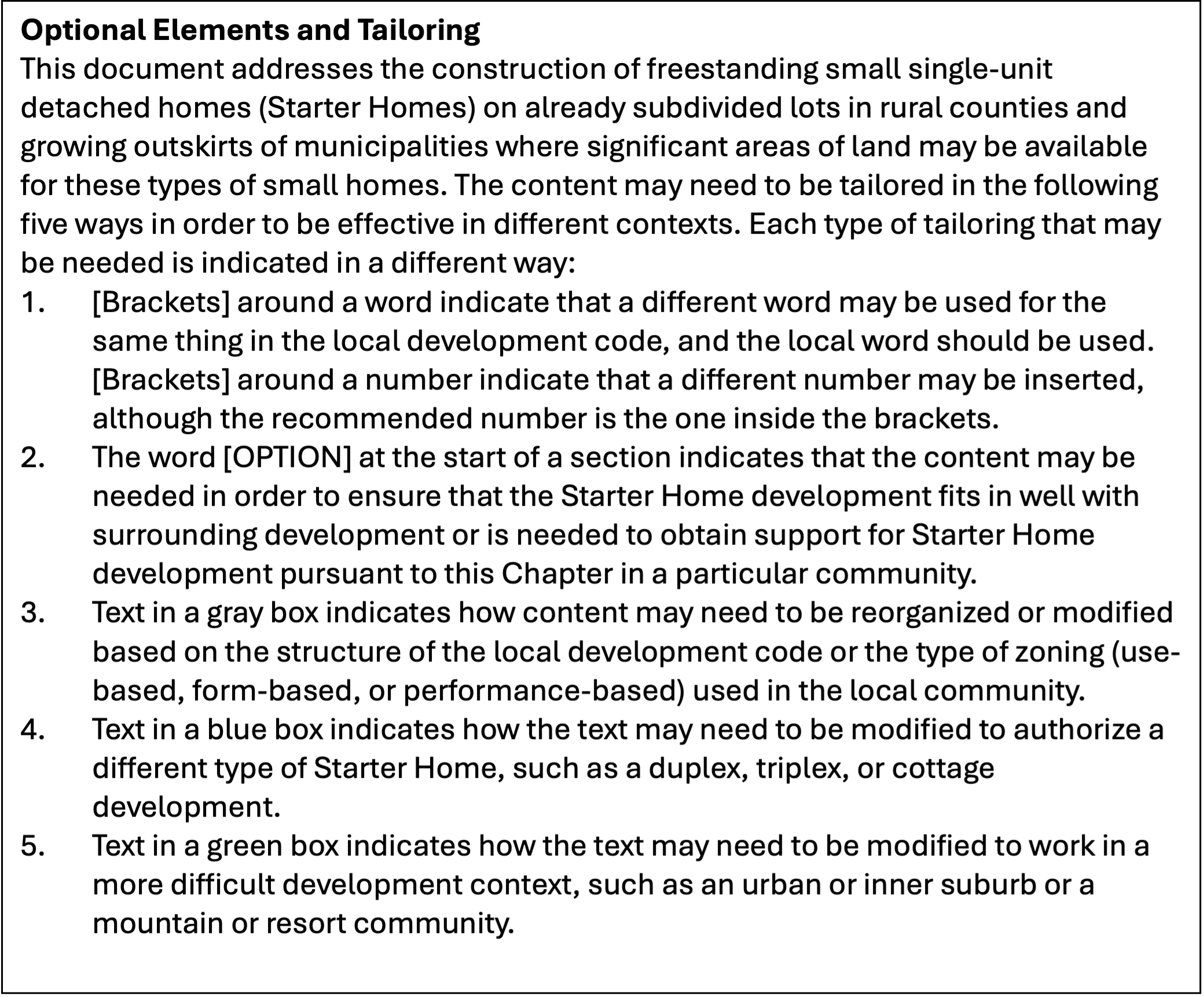
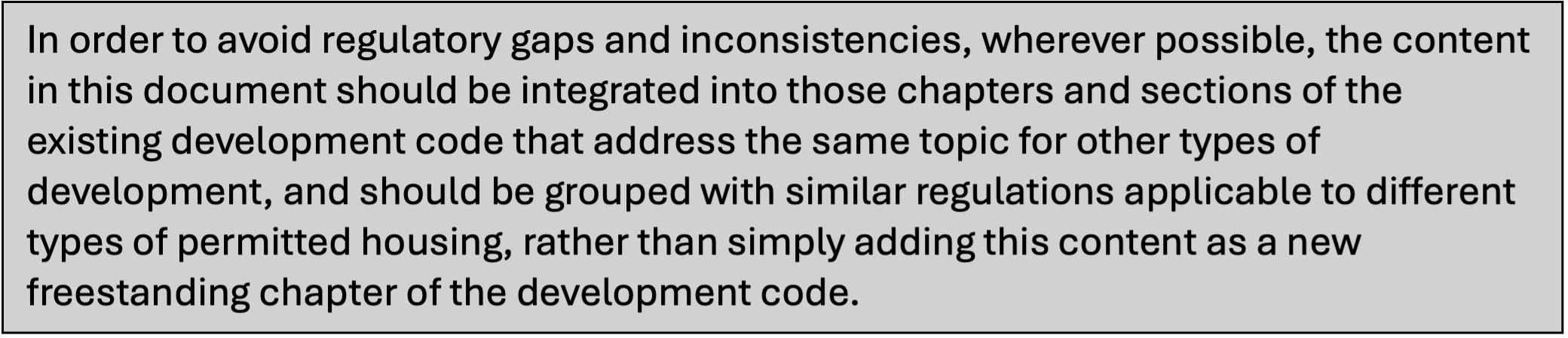
This document describes a simple approach to authorizing development of small detached single-family homes that can open up new opportunities for affordable homeownership through construction of types and sizes of homes often prohibited by local zoning codes. Once land is zoned into the proposed R-SH (Residential Starter Home) zone district and land has been subdivided, all aspects of a Starter Home development can be approved administratively and staff are given significant flexibility to approve proposed developments that meet the intent of the R-SH zone district even if the specifics of the development do not exactly meet the development standards in this document.
With or Without Accessory Dwelling Units
1. Purpose
1.1. General
The purpose of this Chapter is to authorize the construction of small, freestanding single-unit dwellings (Starter Homes) on small individual lots, or on parcels of land containing defined areas for multiple Starter Homes, subject only to compliance with objective standards clearly related to the protection of public health and safety, with compliance being confirmed administratively rather than through a discretionary decision-making process, in order to reduce the time, expense, and uncertainty of development approvals.

1.2. Relationship to Other Development Regulations
The following sections of this [development code] shall continue to apply to Starter Home development authorized by this Chapter, unless modified as listed below. In case of direct conflict between any standard in a different Chapter of this [development code] or regulation and the standards in this Chapter, the provisions in this Chapter shall apply.
1.2.1. List of Sections of the Development Code and any exceptions to standards in that Section otherwise applicable to single-unit detached residential development].
2. Single-Family Starter Home (R-SH) Zoning District
2.1. Creation
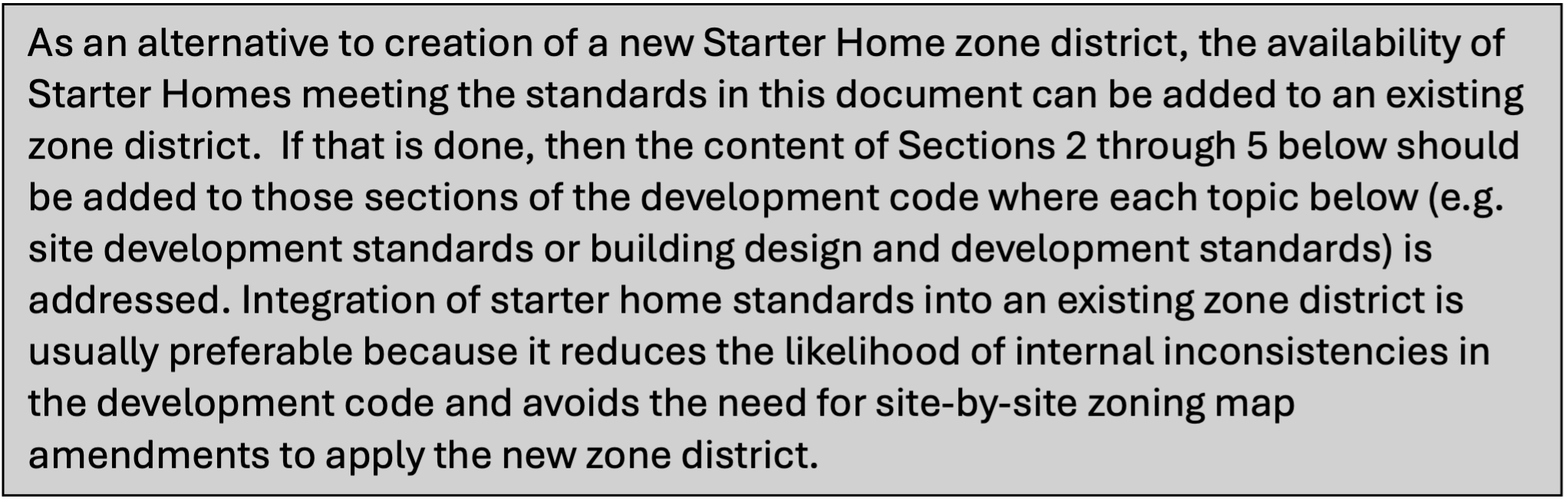
The Single-Family Starter Home Zoning District (R-SH) is hereby created. The provisions of this Chapter shall apply in those areas designated as (R-SH) on the [official zoning map].

2.1.1. [OPTION] Maximum Size of a Starter Home Development
No SH zone district shall include more than [20] gross acres of land unless the land is divided into phases, each of which contains not more than [20] gross acres of land, that are separated from each other by significant natural or man-made features including but not limited to rock outcroppings, landforms, water features, storm drainages, or designated open spaces at least 50 feet in width, or by collector or arterial streets meeting local street standards.
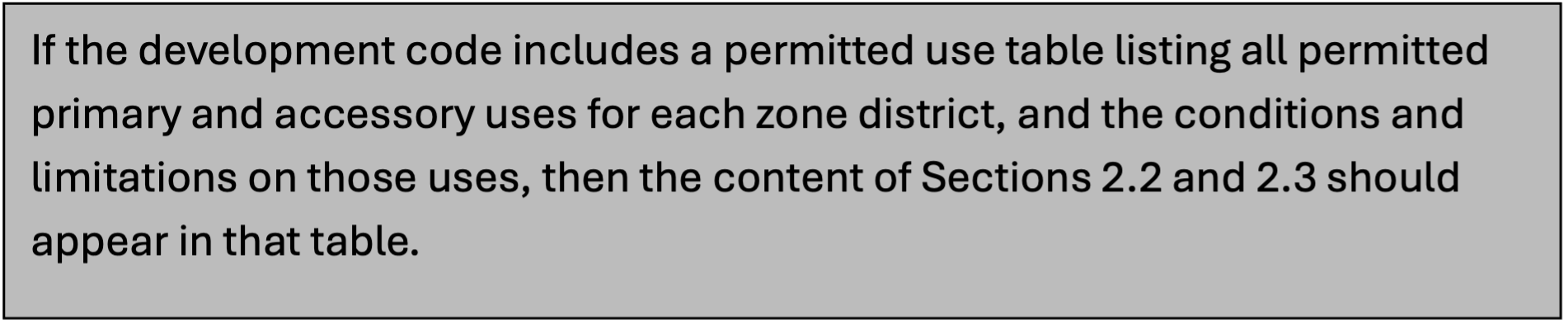
2.2. Permitted Primary Uses of Land
2.2.1. A Starter Home, as defined in Section 6 below.
 2.2.2. Park or open space.
2.2.3. [OPTION] Community garden.
2.2.4. [OPTION] Community center.
2.2.5. [OPTION] Recreation facility.
2.3. Permitted Accessory Uses of Land
2.3.1. One internal Accessory Dwelling Unit containing between 500 and 800 square feet of gross floor area, located within the exterior walls of each Starter Home, and subject only to those standards permitted by C.R.S. 29-35-101 et. seq.
[OPTION] One external Accessory Dwelling Unit containing between 500 and 800 square feet of gross floor area, located outside the exterior walls of each Starter Home, and subject only to those standards permitted by C.R.S. 29-35-101 et. seq.
3. Site Location and Dimensional Standards
3.1. Site Location Standards
A Starter Home development may not be located in the following areas as shown on a map adopted by [Community]:
3.1.1. Flood risk areas as shown on adopted maps of the Federal Emergency Management Agency (FEMA).
3.1.2. Wildfire hazard areas as shown on the most recent Wildfire Risk Map or the Wildland Urban Interface Risk maps maintained by the Colorado State Forest Service.
3.1.3. Any map of steep slope areas, geologic hazard areas, seismic hazard areas, or other areas on which single-family detached development is prohibited.

3.2. Minimum Lot Dimensions
Each lot containing a Starter Home, with or without an ADU, shall contain at least [1,000] sq. ft. of gross lot area, plus any additional lot area required to meet the minimum on-site open space requirements of Section 3.2 and the minimum building location and separation requirements of Section 4.1.[1]

3.2.1. [OPTION] Up to [5] Starter Homes may be located on a single platted residential development lot, provided that a separate Starter Home Development Site is identified for each home in an administrative document acceptable to [Community], and each Starter Home Development Site is adequate to meet the minimum size requirements of Section 3.1, the minimum on-site open space requirements of Section 3.2, and the building separation requirements of Section 4.1.
3.2.2. [OPTION] One or more residential development lots or Starter Home Development Sites within a Starter Home development may contain a gross area up to 20 percent smaller than that required by Section 3.1, provided that at least an equal or greater number of lots within the same Starter Home development contain gross floor areas up to 20 percent larger than that required by Section 3.1, so that the total gross area of all residential development lots in that Starter Home development is not reduced.
3.3. Minimum On-Site Open Space
Each lot containing a Starter Home, with or without an ADU, shall contain an open space containing at least [150] square feet of gross lot area, with no dimension of such open space being smaller than [6] feet.
[OPTION] The minimum on-site open space requirements of Section 3.2 may be reduced to [100] sq. ft. for one or more lots in a Starter Home development, provided that each one square foot of the reduction is replaced by at least one square foot of community open space in a park or open space located so that the nearest corner of the community open space is within [660] feet of the nearest corner of each lot where the on-site open space has been reduced.

4. Building Design and Development Standards
4.1. Building Location and Separation
4.1.1. The minimum front setback of a Starter Home with a front-access garage shall be [5] feet, provided that the front setback of any portion of the lot designed or designated for parking of vehicles in front of the garage shall be [15] feet.
4.1.2. The minimum side and rear setbacks of a Starter Home shall be those required by the adopted fire safety code or the adopted on-site storm drainage design requirements, whichever are larger, provided that the side and rear setbacks for an external ADU shall not exceed those permitted by C.R.S. 29-35-102(18).
[OPTION] The minimum side lot line setback required by Section 4.1.2 does not need to be satisfied on each individual platted lot, but may instead be treated as minimum building separation standards that can be met by providing the required distance entirely or partially on one of two contiguous lots, provided that each lot owner is provided an easement at least [5] feet in width to maintain any portion of a primary or accessory building located less than [5] feet from a side or rear lot line or the side or rear of a Starter Home Development Site.

4.2. Maximum Building Heights
The maximum height for a Starter Home shall be [38] feet.
4.3. [OPTION] Building Design Standards
No more than [3] Starter Homes with the same façade design shall appear on contiguous lots along the same block frontage. At least every [4th] Starter Home located on each block frontage shall differ from the adjacent Starter Homes in design or appearance. The difference in design or appearance may be achieved through changes in façade design or articulation, window or door location or orientation, primary or accent colors or materials, the use of a different façade appearance option offered by the applicant for that model of dwelling, at the option of the applicant, or through any other form of differentiation approved by the Director pursuant to Section 5.3.2.
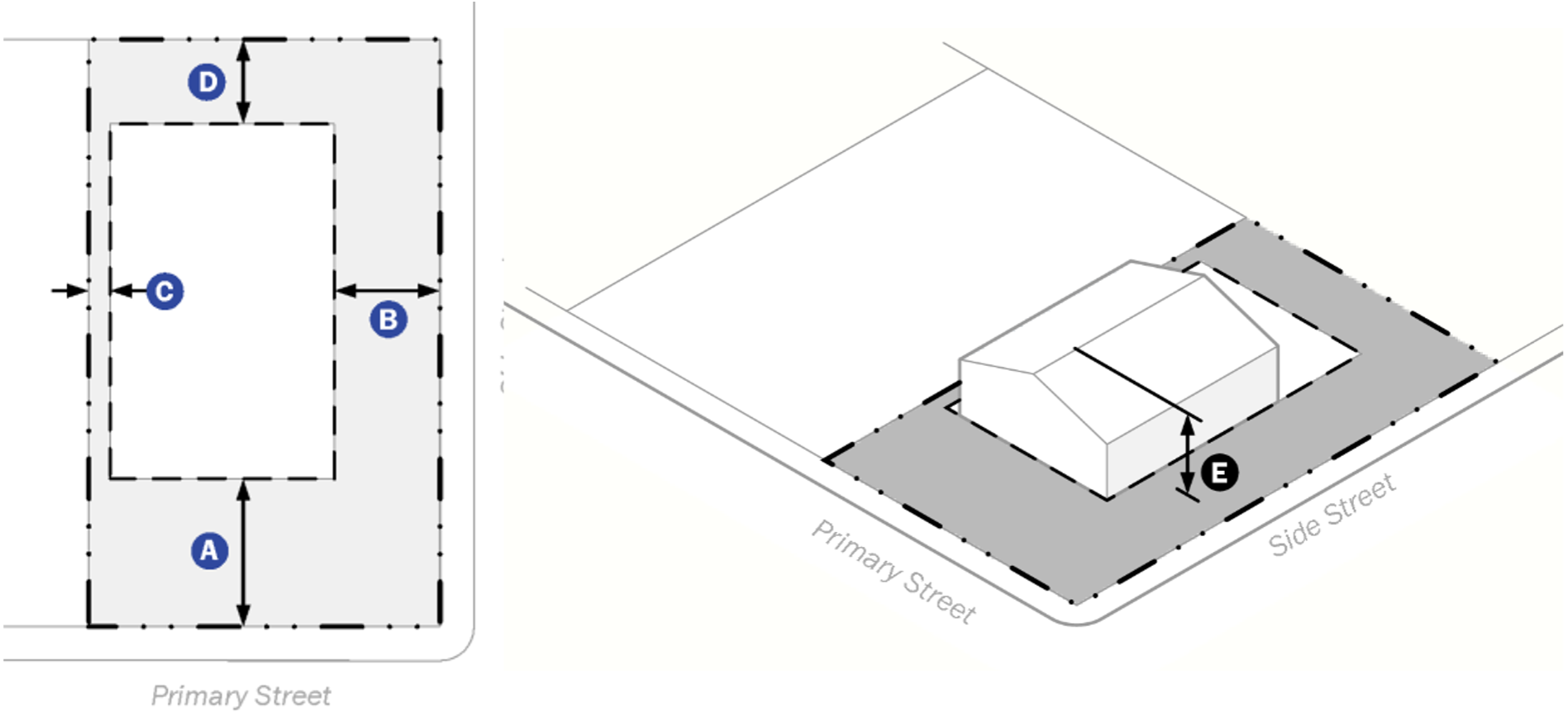
4.4. [OPTION] Starter Home Building Form

Each single-family detached dwelling shall comply with the Starter Home building form shown below.
4.5 Dwelling Unit Size
4.5.1. The minimum size of each Starter Home shall be that required by the adopted version of the International Residential Code, based on the types of rooms and the number of bedrooms included in that dwelling.
4.5.1.1. [OPTION] If [Community] has not adopted any version of the International Residential Code, the minimum size of each Starter Home shall be that required by the applicable building code applied by the Office of the Colorado State Architect for manufactured, modular, or tiny homes. If no such building code is applicable to the proposed type of Starter Home structure, then the minimum size of each Starter Home shall be that adopted by the nearest Colorado county or municipal government that has adopted a residential building code with a minimum size requirement for a detached single-unit dwelling.
4.5.2. The maximum size of a Starter Home is 1,000 square feet of gross floor area.
4.6. Parking
No on-site parking shall be required on individual Starter Home lots, and no shared off-site parking areas shall be required to provide parking for Starter Homes.
4.7. [OPTION] Landscaping
4.7.1. Each block frontage shall contain at least one street tree for every [35] feet of street frontage. Each such tree shall be selected from [Community’s] adopted list of approved tree species, or if there is no such list, then of a very low to moderate water use species acceptable for the region, as defined by a regionally specific plant list.
4.7.2. No landscaping shall be required on individual Starter Home lots.
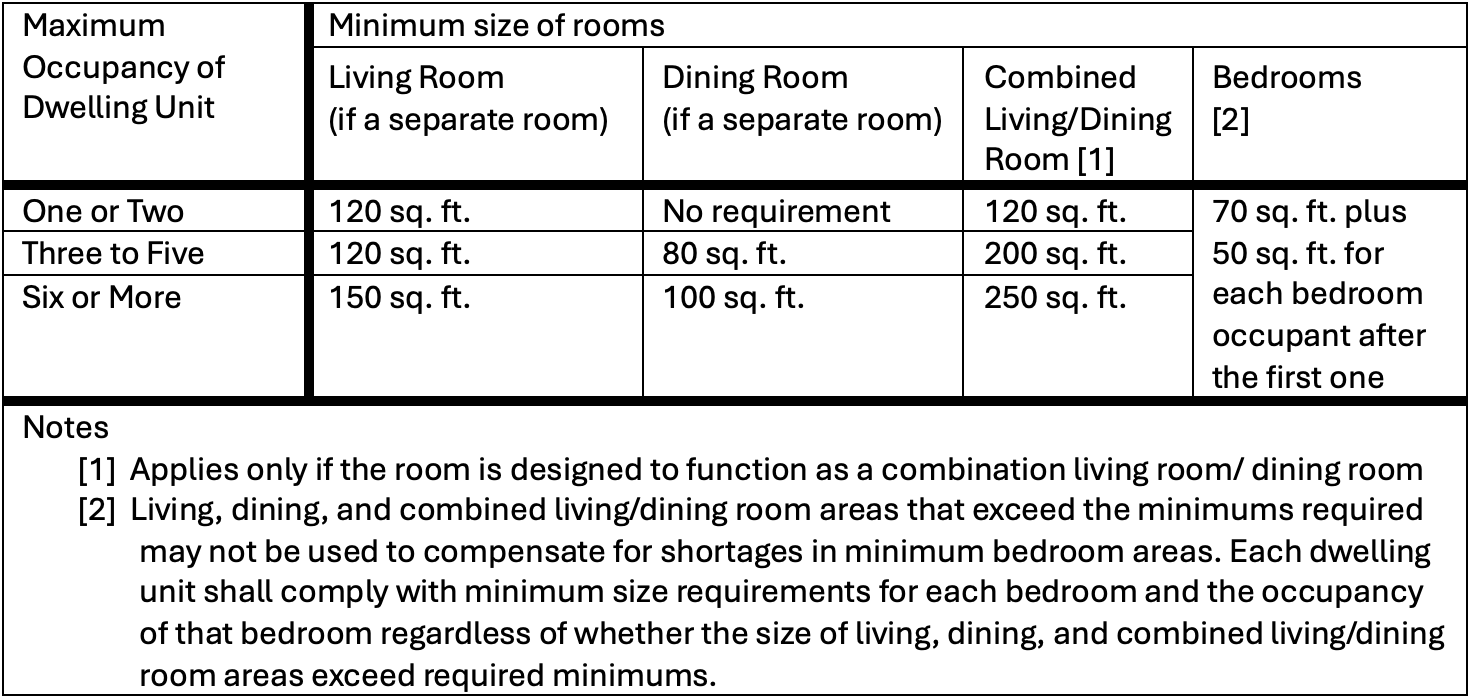
4.8. [OPTION] Maximum Occupancy
The maximum occupancy of each Starter Home shall be as shown in the following table.

5. Administrative Approval Procedures for SH Developments
Following rezoning of land into the R-SH zone district, and the approval of subdivision plat reflecting the Site Dimensional Standards in Section 3, all approvals of Starter Home development shall be administrative and shall not require additional public hearings or approvals from an appointed or elected body.
5.1. [OPTION] Pre-Application Meeting
The applicant shall attend one pre-application meeting with the Director or designated staff to review the proposed location, layout, and proposed land uses in the Starter Home development. If the design(s) of the proposed Starter Homes is known, this meeting can also discuss the compliance of those proposed designs with the Building Design and Development Standards in Section 4 and the need for any administrative amendments of those standards pursuant to Section 5.3.2.
5.2. Application
5.2.1. The applicant shall file a complete application with the Department, including all required documentation necessary to review compliance with all applicable development standards, together with all application review fees and adopted development impact fees.
[OPTION] At the applicant’s option, the application may cover all of a proposed Starter Home development or only a portion or phase of the proposed development. If the applicant discloses the full extent of the proposed development but chooses to submit an application for only a portion of the development, the zoning standards applicable to later phases disclosed at the time of the first application shall be those applicable in this Chapter.
5.2.2. The Director shall promptly review the application and shall notify the applicant of any missing or inadequate materials within [7] days after receipt. This [7] day review and notification procedure shall apply each time the applicant submits additional or revised materials until the Director notifies the applicant that all required materials have been submitted.
5.3. Review, Revision, and Final Decision
5.3.1. Once the Director has confirmed that the application is complete, the application will be reviewed for compliance with the standards in this Chapter and with all applicable standards for Starter Home development, as those standards are modified by Section 1.2.
5.3.2. If the Director determines that the application does not meet some or all of the requirements of Sections 3.2 (Minimum On-Site Open Space), 4.1 (Building Location), 4.3 (Building Design Standards), 4.4 (Starter Home Building Form), or 4.7 (Landscaping), the Director may adjust those standards to accommodate an alternative included in the application provided that the Director determines that the proposed alternative:
5.3.2.1. Is consistent with the purposes of this Chapter;
5.3.2.2. Provides equal or superior visual appearance of the dwellings, or the development as a whole, when viewed from public rights-of-way and adjacent public parks or open spaces;
5.3.2.3. Provides equal or superior privacy and buffering of any impacts on each dwelling of activities on adjacent residential properties;
5.3.2.4. Provides equal or superior quality of parks or open spaces or access for residents to those parks or open spaces; and
5.3.2.5. [OPTION] Provides equal or superior variation in the appearance of Starter Homes viewed from within the development.
A final decision of approval, conditional, or denial shall be made within [90] days after receipt of a complete application. Any conditions attached to the approval shall only be those required to bring the proposed development into compliance with the standards in this Chapter and other adopted and applicable development standards, as those standards may have been modified pursuant to Sections 1.2 and 5.3.2 above. An application shall only be denied if the application fails to comply with the standards in this Chapter and other adopted and applicable development standards and cannot be made to comply with those standards through the approval of alternatives permitted by Section 5.3.2 and acceptable to the Director.
6. Definitions
6.1. Accessory Dwelling Unit
A dwelling unit that is located internal to, or attached to, or separated from the primary dwelling unit on a property, that (a) provides complete independent living facilities for one or more individuals; (b) is located on the same lot or designated development area as the primary dwelling unit, and (c) includes facilities for living, sleeping, eating, cooking, and sanitation.
6.2. Community Center
A building, together with accessory structures and uses, used for recreational, social, educational, or cultural activities by and for the benefit of community groups and individuals, and that is not operated for profit.
6.3. Community Garden
A public or not-for-profit area for the cultivation of fruits, flowers, vegetables, or ornamental plants by more than one person or family, who share the crops.
6.4. Department
The [Community Planning Department].
6.5. Designated Starter Home Site
A portion of a platted lot or parcel whose boundaries are shown on a document in form and substance acceptable to [Community] and designated for (a) construction of a Starter Home, and (b) if the Starter Home footprint does not contain an Accessory Dwelling Unit, then an attached or freestanding Accessory Dwelling Unit. Up to [5] individual Designated Starter Home Sites may be shown on a single subdivided lot or parcel.
6.6 Director
The person responsible for managing or directing the activities of the [Community Planning Department].
6.7. Recreation Center
A place designed and equipped for the conduct of sports, leisure time activities, and other customary and usual recreational activities, and that is not operated for profit.
6.8. Starter Home
A single-unit detached dwelling containing not more than 1,000 square feet of gross square area, which may at the developer or owner’s option include an Accessory Dwelling Unit within the footprint of the primary structure. This definition includes homes built entirely or partially in an off-site facility and installed or assembled on site, as well as homes constructed on site.

[1] Note: Colorado law does not permit local governments to require a larger lot size for single-family dwelling units that have an external or detached ADU compared to the minimum lot size for a single-family dwelling without an ADU.