Colorado Is Home to a Vibrant Philanthropic Sector: Driving Billions in Economic and Social Benefits
Introduction and Key Findings
As Alexis de Tocqueville observed nearly two centuries ago, private giving is an essential part of the American enterprise. In Democracy in America, the French philosopher highlighted Americans’ unique commitment to philanthropy—the desire to use one’s own talent and treasure to promote the welfare of others. “Americans of all ages, all conditions, all minds constantly unite,” he wrote. “Americans use associations to give fêtes, to found seminaries, to build inns, to raise churches, to distribute books, to send missionaries to the antipodes; in this manner they create hospitals, prisons, schools.”
In societies with large and growing governments, it can be easy to doubt the need for private giving and dismiss the essential role philanthropies play in solving difficult social challenges.
This report explores the impact of philanthropy—how and whether it contributes to vibrant communities, growing economies, the strength of families, individual educational outcomes, and more. It examines what Colorado would look like without its philanthropic sector and attempts to quantify what level of taxation would be necessary to replace the state’s vibrant tradition of private giving.
What CSI’s data, along with a review of existing research, shows is that it would be virtually impossible for Colorado communities to function and thrive without private giving. Health and education systems would weaken, poverty rates would rise, innovation would diminish, and the fabric that ties together people of differing views and backgrounds would fray.
In Colorado, the spirit of community enterprise is alive and well. The state is home to hundreds of private family, community, and corporate foundations, tens of thousands of nonprofit organizations[i], and a citizenry that is among the most charitable in the nation, both in terms of monetary contributions and volunteerism. (In 2023, Colorado ranked second among all states in the share of its residents who gave to nonprofit organizations.) The state’s philanthropic sector reduces long-run demand on public services and stimulates economic growth resulting in broader gains for taxpayers, employers, and communities statewide.
As Colorado celebrates its 150-year anniversary, its leaders should recognize and champion the state’s enviable record of philanthropy, particularly in light of the ongoing crisis of social disconnection and isolation, and in an era of tightening government budgets.
Key Findings
Replacing Individual Charitable Giving in Colorado Would Require a Massive Tax Increase
- In 2025, CSI estimates that Coloradans gave $6.1 billion to charity, an amount equal to roughly 61% of all individual income tax revenue collected by the state in FY 2024-25.
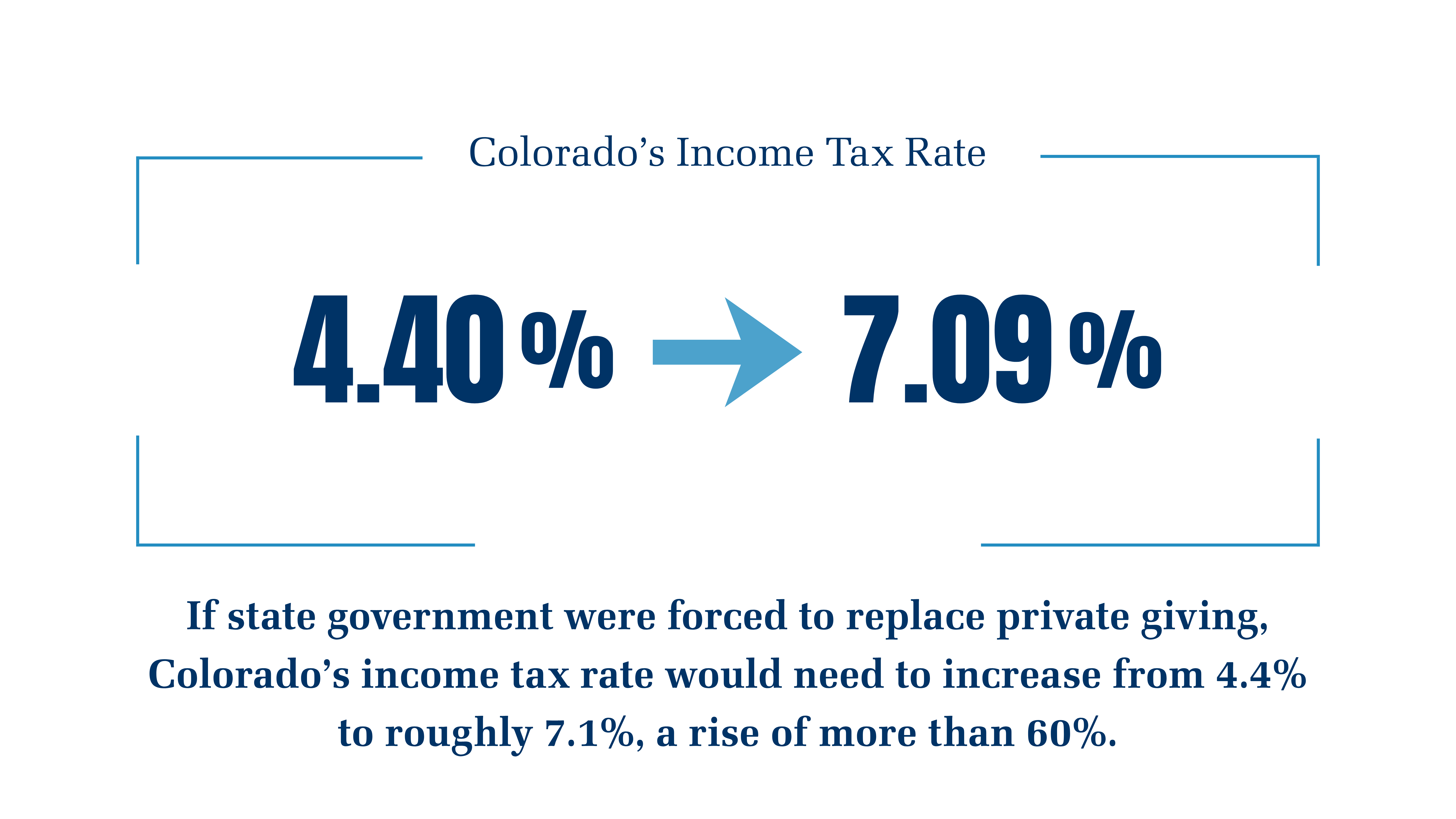
- Even under the generous assumption that government could replace those services dollar-for-dollar and with equal efficiency, replacing that lost giving would require raising Colorado’s flat income tax rate by more than half from 4.40% to 7.09%.
- Coloradans also contribute an estimated 110 million volunteer hours each year, equal to about 36% of the annual hours worked by the entire state government workforce.
Coloradans are Generous With Their Time and Treasure
- In 2023, Colorado ranked 2nd nationwide in the share of residents who donated charitably, with an estimated 62% of the population giving that year.
- Across all four U.S. Census-tracked measures of philanthropic behavior — charitable giving, informal helping, formal volunteering, and talking with neighbors — Coloradans participated at rates above the national average.
- When each state’s rankings in these four metrics are aggregated in the Philanthropic and Community Service Index, Colorado ranks 3rd in the nation.
Government Expansion Can Weaken Private Philanthropy
- Charitable giving responds to incentives, meaning tax policy can materially affect how much private giving occurs.
- Multiple studies reviewed for this report find that as government support/spending in specific sectors expands, private donations and nonprofit fundraising often decline.
- In practice, this means policymakers should view private giving as something government decisions can either encourage or erode.
The High Cost of Replacing Colorado’s Private Giving
As this report will demonstrate, there are many benefits to Americans’ strong commitment to private giving. One benefit is that it takes pressure off government to provide much needed health, education, housing, and economic welfare programs.
Relieving this pressure has serious benefits for taxpayers.
To frame the scale and importance of philanthropic giving by Coloradans, CSI estimated how much the state’s income tax rate would need to increase if charitable giving ceased and the state government were to assume responsibility for the services currently provided by the philanthropic sector. For the purposes of the scenario below, CSI assumes that the state government would be as efficient as the philanthropic sector and require no additional funding in excess of charitable giving, although there is general evidence that the philanthropic sector is more effective at distributing resources than government.
Since no single estimate of individual giving exists for Colorado, CSI estimated Colorado’s 2025 charitable donations using publicly available state and national level Internal Revenue Service (IRS) tax data combined with Giving USA national individual giving estimates. Using this data, we estimate that in 2025, Coloradans made $6,121,141,184 in charitable donations. In fiscal year (FY) 2024-25, Colorado collected $9,997,900,000 in individual income tax revenue, meaning that Colorado’s estimated charitable giving was equal to 61% of the total amount collected through its income tax in one year.
In other words: if philanthropic giving ceased in the state, and the government was left to fill the resulting $6.1 billion+ hole, lawmakers would need to increase the state's income tax rate by more than half (2.69 percentage points), from its current flat rate of 4.40% to 7.09%.
Coloradans do not only give monetarily, however. They also donate their time by volunteering in their community at rates above the national average.
CSI identified one estimate of Colorado’s annual nonprofit volunteer hours, but that figure excludes volunteer activity that occurs outside formal nonprofit organizations. To develop a broader estimate of statewide volunteer activity, CSI used the most recent AmeriCorps/U.S. Census data.[ii]
Using these data sources, CSI estimates that Coloradans collectively contribute approximately 110 million volunteer hours annually. For comparison, in January 2026, Colorado employed 145,000 state government workers. Assuming full-time employment, those 145,000 employees worked roughly 301.6 million hours in a year, meaning total
annual volunteer hours in Colorado were equal to about 36% of the total annual hours worked by the state government workforce.
The Broad Benefits of Philanthropy
Private giving houses, feeds, and educates people in need; it enhances and beautifies the communities we live in; it offers people access to new pursuits and new ideas; and it expands opportunity, both social and economic.
The Economic Benefits of Philanthropy
The philanthropic sector is also an important part of the U.S. economy. According to Independent Sector, a national organization that connects, strengthens, and advocates for nonprofits and philanthropies, the United States’ 1.9 million nonprofit organizations contributed $1.5 trillion to the U.S. GDP in 2024, or about 5% of the total economy.[iii]
Researchers have found a strong connection between capitalism, entrepreneurship, and philanthropy.[iv] In the United States, private foundations operated by high net worth individuals and corporations are responsible for a large portion of private giving. There are 193,720 foundations nationwide. Combined, these organizations employ more than 402,000 people, earn more than $475 billion in revenue annually, and have assets of about $2 trillion.[v] Private foundations, along with independent and community foundations, contributed an estimated $109.81 billion in 2024, or about 18.5% of the $592.5 billion donated that year.[vi] Together, private foundations provide the backbone of funding for more than 1.5 million nonprofits operating in communities all over the country.[vii]
The Social Benefits of Philanthropy
The benefits of private giving extend far beyond economics.
Research indicates that offering one’s time and talent can drive happiness and social cohesion as well. After conducting national surveys and in-depth individual interviews, the authors of The Paradox of Generosity concluded “the more generous Americans are, the more happiness, health, and purpose in life they enjoy.”[viii]
Private Giving Is More Efficient, Inventive, and Humane
While we will consider this topic in more depth later in this paper, according to researchers at Indiana University, data provides evidence that government crowds out private giving. Whether, and to what extent, government spending erodes private giving is a secondary question, however. What is most important to realize is that the nonprofit sector plays a crucial role in today’s diverse societies.[ix]
One reason the philanthropic sector is so important is that it is often much more effective and efficient than government. According to finance writer Joel Lim, research shows that 70% of government assistance outlays are spent to uphold the bureaucracies. Only 30% actually goes to helping the poor. In private organizations, the numbers are flipped. Private charities give more than 70% of their proceeds to the poor.[x] Private organizations, Lim argued, also offer more customized, inventive, individualized, and humane solutions. Research from the Philanthropy Roundtable agrees with that assessment.[xi]
Private charitable organizations’ effectiveness is reflected in public polls as well. A 2025 survey by Independent Sector[xii] found Americans trust nonprofits and private foundations more than local, state, or federal governments.
Private Foundations in Colorado Embody the State’s Philanthropic Spirit
In the United States, giving by private foundations between 1982 and 2022 increased at more than twice the rate of giving from individuals, estates, and corporations.[xiii]
In Colorado, private foundations also help drive the state’s philanthropic spirit. The state is home to hundreds of private family, community, and corporate foundations that provide a significant portion of charitable giving. (Private family foundations are typically operated and funded by only a single donor or that donor’s family. Community foundations like the Denver Foundation aggregate the giving of many private donors, as well as private foundations. Corporate foundations are operated and funded by a single company.)
Colorado Foundations Support Health, Education, and Welfare Programs and Drive Innovation and Scale
Foundations based outside Colorado also help Colorado causes. Indeed, about 60% of overall foundation giving in Colorado comes from foundations based outside of the state.[xiv] There is no doubt that homegrown giving drives positive change in the state, however. Regardless of where a foundation is based, according to Philanthropy Southwest[xv]:
- The El Pomar Foundation, established in 1937 by Spencer and Julie Penrose, seeks to enhance, encourage, and promote the current and future well-being of the people of Colorado through impactful grant making across a broad scope of initiatives; with a enhanced focus on arts & culture, civic/community initiatives, education, health, and human services. Over the Foundation’s 88-year history, more than $1.4 billion in total support has been awarded through more than 25,000 grants.
- The Daniels Fund, founded by Greeley native and cable television pioneer Bill Daniels, is the second-largest charitable foundation in Colorado by assets. The Fund focuses its giving in Colorado and three other Mountain West states, providing grants to highly effective nonprofit organizations across eight funding areas, as well as full-ride college scholarships for the next generation of American leaders.
- The Daniels Fund brings an entrepreneurial approach to philanthropy through its Big Bets initiative, tackling some of the nation’s most pressing challenges with innovative solutions designed to scale. These efforts include launching the National Civics Bee and Youth Sports Giving Day, dramatically expanding education choice opportunities, and supporting groundbreaking solutions to homelessness.
- The Adolph Coors Foundation supports organizations that promote the western values of self-reliance, personal responsibility and integrity. The Foundation places a high priority on programs that help youth to prosper, encourage economic opportunities for adults, and help advance beneficial public policies. Specifically, the Foundation’s traditional areas of support include one-to-one mentoring programs for youth, paid on-the-job training, and a variety of self-help initiatives.
- The Temple Hoyne Buell Foundation, established in 1962 by Denver architect, real estate developer, and philanthropist Temple Hoyne Buell, supports efforts to improve the lives of young children and families throughout Colorado. Since narrowing its focus to early childhood in 1996, the Foundation has partnered with organizations across the state to support early childhood education and development, with an emphasis on children from birth to age five, underserved communities, and rural Colorado.
As the threat of wildfires continues to grow across the western United States, organizations like the Bohemian Foundation have stepped up to aid communities. In June 2025, the Bohemian Foundation provided significant support, including a $500,000 grant to the Center for Disaster Philanthropy to strengthen long-term disaster recovery in the U.S. and globally.[xvi]
Innovating to scale impact is another important priority for Colorado donors. In 2025, the Boettcher Foundation supported 14 Boettcher Fellows, exceptional community leaders, with coaching, curriculum, and funding to amplify their impact across Colorado. The Foundation’s work includes grantmaking, leadership development, scholarships for high-potential Colorado students, and biomedical research support, all rooted in a long-standing commitment to Colorado and the potential of Coloradans. Last year, the foundation also hosted the Boettcher Service Summit on food insecurity, gathering scholars, alumni, and partners to develop hands-on service models and solutions.[xvii]
Colorado’s Top 100 Foundations Provide $4.7 Billion in Direct Impact
A report from the University of Colorado Denver School of Public Affairs[xviii] found that in 2020:
- Colorado’s foundation assets totaled approximately $15.6 billion, representing the 16th largest amount for a state.
- Colorado ranked 20th out of all U.S. states for the number of foundations per capita with one foundation for every 3,159 residents.
- Colorado ranked 21st for foundation assets per capita. ($2,686 per capita compared to the national median of $1,922.)
- Colorado’s largest 100 foundations made $531 million in grants, resulting in an estimated $4.68 billion in direct benefits to the economy.
Figure 2:
Giving by Colorado’s Foundations Continues to Grow
According to Philanthropy Colorado’s 2025 report, giving by Colorado-based foundations increased from $502 million in 2006 to $1.55 billion in 2022, a more than three-fold increase.[xix]
Philanthropy Southwest data shows foundation giving totaled $1.4 billion in 2023. Based on data from that organization, Figure 2 shows Colorado foundations’ giving by cause that year. Spending on health led the way, with $254 million in grants awarded to health-related causes that year. Causes related to education and human services were second and third, respectively. Each of those two categories received more than $200 million in grants in 2023. As alluded to earlier, private foundations also support arts and cultural pursuits, human rights causes, sports and recreation opportunities, care for the environment and agriculture, public safety programs, and science and engineering.
The largest foundations in Colorado awarded more than 27,000 grants in 2023. Based on data from Philanthropy Southwest, Figure 3 shows private family, community, and corporate foundation giving leaders in Colorado in 2023. That year, the Denver Foundation, the Colorado Health Foundation, and the Anschutz Foundation were the largest donors.
Figure 3:
The Denver Foundation, established in 1925, is one of the first 25 community foundations in the United States. It helps donors plan for their city’s future through endowments, donor-advised funds, and, eventually, other types of charitable funds.
The Colorado Health Foundation was established in 1995 as the HealthONE Alliance after the nonprofit hospital system HealthONE entered into a joint venture with Hospital Corporation of America. It was rebranded in 2006 as The Colorado Health Foundation.
Founded in 1984,
The Anschutz Foundation is a private charitable foundation established by Philip F. Anschutz. It has given substantially to hundreds of nonprofit organizations, primarily concentrated in Colorado. The organization awards about 500 grants a year focused on five program areas: health and wellness, human services, youth development and education, quality of life and development, and values and relationships.
As Figure 4 shows, the vast majority of the tracked money donated by Colorado-based foundations stayed in Colorado. Of the total given, $565 million, or 70%, remained in the state across more than 9,000 grants. About $233.9 million, or 29%, went to other U.S. states and only $6.9 million went to international organizations.
Figure 4:
Colorado Is Among the Most Generous States
While private, community, and corporate foundations make up the bulk of philanthropic giving in the state, residents also give significantly. Everyday citizens contribute their hard-earned dollars to hundreds of causes, and they show up to volunteer for these organizations as well.
As noted earlier in this report, CSI estimated 2025 charitable donations using publicly available state and national level IRS tax data combined with Giving USA national individual giving estimates. Using this data, we estimate that in 2025, Coloradans made $6,121,141,184 in charitable donations. In FY 2024-25, Colorado collected $9,997,900,000 in individual income tax revenue, meaning that Colorado’s estimated charitable giving was equal to 61% of the total amount collected through its income tax in one year.
The collective spirit of helping one’s neighbor and community has propelled Colorado to the top of the country in terms of private giving.
CSI Index: Coloradans Give, Volunteer More Than Other Americans
As seen in Figure 5, data from the U.S. Census Bureau shows Coloradans’ rates of charitable giving and formal volunteering are higher than the national average. Specifically:
- More than one-third of Coloradans, 35%, formally volunteer versus 30% of all Americans, earning the state 12th place in the U.S. rankings.
- Regarding monetary giving, in 2023, Colorado ranked 2nd nationwide in the share of residents who donated, with an estimated 62% of the population giving that year. That number was 10 percentage points above the national average.
- These metrics have only continued to improve in Colorado in recent years.
The U.S. Census Bureau is not the only organization that offers high rankings for Colorado’s spirit of philanthropy.
Using 17 metrics, WalletHub ranked Colorado as 6th in the nation for philanthropy.
[xx] Colorado ranked 11th in terms of volunteering and 8th in terms of charitable giving.
Figure 5:
To create a Philanthropic and Community Service Index, CSI aggregated each state’s ranking on the four metrics the U.S. Census Bureau uses to quantify American generosity—monetary giving and formal volunteering along with an informal help rate and talking with neighbors. As shown in Figure 6, when considering all four metrics together, Colorado ranks third in the nation, behind only Utah and Montana.
Figure 6:
Case Study: Colorado Gives Day
Started in 2010 by the Colorado Gives Foundation, Colorado Gives Day is a statewide day of giving that encourages Coloradans to support local nonprofits. Since its inception, it has seen dramatic growth in both the annual dollars donated and the number of gifts made each year. From 2010 through 2025, Coloradans donated more than $700 million (inflation-adjusted).
In 2025 alone, Coloradans donated $56.5 million.
Colorado Gives Foundation has also recently partnered with the Daniels Fund, Aspen Institute’s Project Play, and other Colorado foundations to create a day of giving focused on youth sports. Starting in 2024, the project continues to grow with over $5 million raised for youth sports in 2025 alone. These cause-specific giving days present a new and creative way to harness the generosity of everyday Coloradans.
Figure 7 shows the number of annual donations made during each Colorado Gives Day. Throughout the mid-2010s, the number of annual donations increased steadily from just 20,000 in the inaugural year to more than 165,000 in 2019.
In 2025, there were 261,513 donations made through Colorado Gives Day, meaning the average donation that year was around $216.
Figure 7:
Colorado’s Philanthropic Sector Drives Growth, Jobs
Private donors, private foundations, and nonprofit organizations in Colorado address key individual and community needs, including housing, health, education, relief after disasters, and more. By supporting arts and recreation endeavors and providing opportunities for residents to come together to celebrate the things they have in common—and civilly discuss their differences—these institutions also contribute to the vibrancy of the culture.
But that is not all Colorado’s philanthropic sector sustains.
According to Independent Sector[xxi], nonprofits in Colorado are responsible for more than 169,000 jobs, or about 7.1% of the private workforce.
These organizations also provide opportunities for more than 1.6 million volunteers. Combined, nonprofit volunteers in Colorado donate more than 92.4 million hours of service worth approximately $3.4 billion annually.
Philanthropy Colorado estimates the economic impact is even greater. According to its latest report, issued July 1, 2025, Colorado’s 34,251 nonprofit organizations directly employ 182,000 people, sustain another 54,000 jobs in business-to-business activity, and support 26,000 jobs through household spending. Colorado’s nonprofit sector employs more than the agriculture, mining, and information industries combined.
Nonprofits also contribute $25 billion to state gross domestic product and sustain a $62 billion overall economic impact.
How Government Decisions Affect Private Giving
While private giving has a significant positive effect on society, the economy, individual communities, and everyday citizens—and reduces the burden on local, state, and federal governments to address social challenges—evidence indicates the presence of a large and growing government negatively impacts the philanthropic sector.
Government Tax Decisions Affect Donations
Decisions about tax policy have a significant effect on private giving. A 2011 paper published in the National Tax Journal[xxii] concluded “people’s decisions about how much to donate to charity are influenced significantly by tax incentives.” More specifically, using a 1979–2006 panel of tax returns, the authors examined how donations respond to persistent and transitory changes in both the tax price of giving and income. A key feature of the paper is that it separately identifies federal and state tax-price effects; in one of the paper’s preferred specifications, the elasticity with respect to a persistent change in the state price of giving is about -1.16.
A 2024 National Bureau of Economic Research paper[xxiii] examined the effects of the 2017 Tax Cuts and Jobs Act (TCJA) at large, which removed federal charitable-giving incentives for roughly 20% of U.S. income taxpayers. Charitable giving fell by about $20 billion annually after the TCJA. The paper estimated permanent price elasticities range from about 0.6 for the average donor to above 2.0 for taxpayers predicted to be the most responsive to the reform.
Crowding Out: A Real or Imagined Phenomenon?
An earlier section of this paper touched on the idea that increased government spending crowds out private giving. A number of researchers have tackled this question and found that while it is difficult to pinpoint exactly how much rising government spending will crowd out private giving, higher taxes and local, state, and federal outlays will damage the philanthropic sector.
A 2011 paper published in the Journal of Public Economics[xxiv] examined more than 8,000 charities and nearly 40,000 observations and found the crowd out rate to be about 73% to 75%, meaning each $1,000 in government grants is associated with roughly $727 less in private giving. The paper concludes most of the measured effect is due to reduced fundraising by nonprofits, while the portion attributable to classic donor crowd-out ranges from partial crowd-out to slight crowd-in depending on the specification. A 2003 paper[xxv] by the authors of the Journal of Public Economics study found government grants cause significant reductions in private fundraising.
A 2009 paper from the Federal Reserve Bank of St. Louis[xxvi] also found it is difficult to determine whether government spending crowds out private giving but concluded that a “long-run negative relationship does exist between charitable giving and government spending, most notably total giving and education giving. The relationship is less than one-for-one, thus suggesting partial crowding out.”
A 2007 paper from the National Bureau of Economic Research[xxvii] examined whether the expansion of public relief under the New Deal displaced private charitable activity by churches. The authors assembled a nationwide dataset on charitable spending for six large Christian denominations and instrument for New Deal spending using political and institutional variation. Their findings indicate that higher government spending led to lower church charitable activity, making this one of the clearest historical studies of broad public-spending crowd-out in an overlapping service area.
The Bottom Line
The country, and Colorado, remain in a period of economic uncertainty. Inflation persists, technology is changing the job market, and skills and education gaps exist. The 2025 Colorado Health Foundation (CHF) Pulse Poll[xxviii] demonstrates how vulnerable many residents feel:
- Just over half of Coloradans reported experiencing financial challenges in the past year;
- Nearly one-third of residents are worried about affording enough food to feed themselves and their family;
- One in 10 Coloradans have skipped a meal because they cannot afford food; and
- 56% of Coloradans reported experiencing mental health strain—such as anxiety, depression, loneliness, or stress—in the past year.
Government cannot solve these challenges alone, especially given Colorado’s growing budget instability. The state needs a vibrant philanthropic sector.
The spirit of philanthropy that is alive and well in Colorado generates significant benefits for the state and its residents—benefits that cannot be replaced by the public sector even with massive increases in taxation. As the state celebrates its 150th anniversary, it should celebrate and preserve its residents’ commitment to philanthropy, making the state a more exciting and enriching place to live, work, and visit.
Sources